After April left on Sunday, I spent Monday, Tuesday, and Wednesday hiking around the island getting papers filled out for site development for a follow-on PCV, pasear-ing (just chatting) with folks after the health fair, and trying to find a ride out for Thursday. I was successful on the first two. But the only ride I heard about for Thursday was with Efrain, my original guia (guide), who lives on the far side of the island. Since it was about a two and a half hour hike to go see him, I called instead, but had to leave messages. I didn't hear anything until Wednesday evening around 6. Efrain was going out, leaving in the madrugada (middle of the night) with some family who was visiting (it is still summer/dry season here and school is still out), but was willing to swing by our house to pick me up. Around 4am he said. I had a ride!
So I got the house ready for leaving, putting the parts of the kitchen (which is outside) in the back room, pouring out the pee container, burning the toilet paper, and taking down all but one of the hammocks. I set the alarm for 3:36am, which would give me more than enough time to get dressed, drink a glass of water, grab some bread, tie up the trash bag to carry out, and sit in the hammock to await the sound of a boat (while Efrain may be fairly timely, we've learned to be patient awaiting rides out, especially in the madrugada; the hammocks go away in the morning). And I went to bed.
"¡KEVIN!"
Huh?
"¡KEVIN!, ¿esta listo?"
OH MY GOSH, I must not have heard my watch alarm! Nor my phone alarm?
"Si Efrain. Uno momento."
What time is it? Wait, it is 3:32am! He's early!
So I hopped up, pulled on my clothes, grabbed my bag, stuck the water filter in the back room, and left the trash and the hammock; Efrain was ready to get back in the boat. My watch alarm to wake up went off as we were pulling out of our cove. I felt like a Minute Man.
But a two hour ride to port starting at 3:30am can be beautiful. There are no lights along the Gulf (it is a RAMSAR Treaty Protected Wetlands Area) and the view of the stars can be amazing. Although there was a stretch where I thought at first that it must have been cloudy, since the stars were almost blurry and the background was greyer / less black. But over the course of the entire ride, that section of "clouds" never moved. I realized this was a different, early morning, section of the Milky Way from the more distinct stars-on-a-whiteish-background portion we can see in the evening, when we more commonly are out looking up at the stars. (My reaction reminded me of Barack Obama's similar description of watching what he initially thought were unmoving clouds over stars while in Kenya in Dreams From My Father, which I'd initially scoffed at, "knowing" what the clear whiter stretch of the evening night sky was.)
That amazing section of the Milky Way and the other constellations and the several shooting stars visible in the vast expanse of sky were also reflected on the mirror smooth water ahead of our wake. Despite the early hour, I kept my watch, like a Minute Man soldier of old, on the ever constant yet ever intriguing view of a clear star-filled night sky free of light pollution.

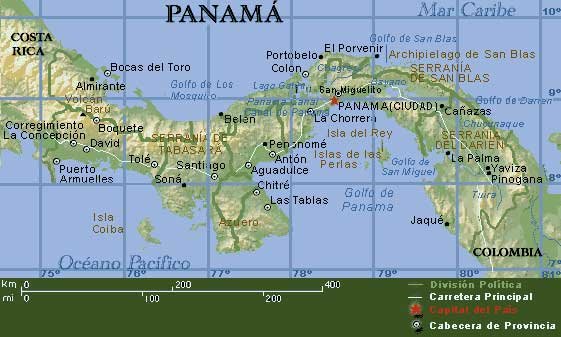
April and Kevin in Kuna Yala, the northeast coast of Panamá
Showing posts with label in-country travel. Show all posts
Showing posts with label in-country travel. Show all posts
Saturday, March 28, 2009


Monday, March 2, 2009
Paul and Sandy's Visitor View
Paul & Sandy’s Visit to Panama 1/28/09-2/9/09
“Short” Recap
“Short” Recap
Q1: How was Panama what you expected?
Panama was about what we expected. Panama is a large metropolitan city surrounded by neighborhoods of varying levels of socioeconomic conditions. We were slightly surprised (but probably should not have been) how poorly many Panamanians live.
Q2: How was it different than what you expected?
The most striking thing for me that was different than I expected was how many Panamanians have cell phones. Regardless of living conditions, they often having more than one phone, and they use them regularly.
About the weather - Absolutely terrific the entire time. Even though it was the dry season and has little rain, we had a 5 day stretch where it rained each day, but not enough to change or alter any of our plans. Temps hovered around 90 during the day with a breeze and maybe high 70s in the evening for lows.
About insects – maybe it was because it was the dry season, yet we had little contact with them on our skin. I saw only a few mosquitoes flitting about. I was gnawed on by some no-see-ums a few times but probably only because I washed the bug repellent off when I washed my hands. We were infested with tiny micro sized ticks after our trip to Barro Colorado, and spent a day or so picking them off of us as we discovered them. They were hardly a nuisance, and since they don’t carry Lyme disease, we were not worried.

The little dot to the left of the penny is a tick
Q3: What struck you about the USA when you returned home?
When we returned to the US, I was struck and moved by the US immigrations officer’s declaration as we were leaving his station, “Welcome back Home folks.”
Q4: What was your best moment in Panama?
See below about walking to the tienda on the island.
Q5: What did you find most interesting or most notice about Kevin and April's life in Panama?
Concerning April & Kevin’s life in Panama, I was struck on how connected they were to the Cuerpo de Paz (Peace Corps) organization in Panama. I certainly didn’t realize they had so much contact with the organization on a regular basis. I also get the sense that they don’t fully realize the impact they are having on the people they work with on the island and in the Peace Corps organization. April’s & Kevin’s Spanish is outstanding, and it was great fun watching them negotiate and arrange things in Spanish.
Q6: Free response - anything else you´d like to say about your trip and time here.
Sandy’s and my visit to Panama to visit Abril y Kevin consisted of three parts:
1. A few days in Santa Fe, Veraguas, an hour and a half north of Santiago
2. Several days on their island
3. Four days in Panama City
1. A few days in Santa Fe, Veraguas, an hour and a half north of Santiago
2. Several days on their island
3. Four days in Panama City
Our trip getting to Panama was eventful only in that winter descended on Cincinnati the day before our departure, which resulted in our flight from Cincinnati to Miami being cancelled at the last minute. This cascaded into us flying to Ft. Lauderdale and taking a taxi to Miami; then missing our scheduled flight to Panama. Yet, somehow we managed to get to Panama just a couple of hours later than our original scheduled arrival time.
After wading through Immigration and Customs in Panama, we found Abril y Kevin waiting for us. They were with Brian Naranjo, part of April & Kevin’s Embassy host family in Panama. When in Panama City, April & Kevin stay with them, thus saving some money. Brian is the senior political officer for the State Department at the US Embassy in Panama. Now, as most of you know, I am NOT a big fan of our federal government, particularly the State Department which I feel is a big unwieldy bureaucracy, yet after visiting with Brian and Devon, I am happy we have people like him representing the interests of the US abroad. If all State Department political officers were like him, we would be in good shape.
One of first things we learned about Panama is that Panama has a pretty decent transportation system. Not sophisticated but serviceable. The buses between most major cities are large and clean. There are plenty of mini-buses or “coaster buses” to go between smaller places. Now in Panama they play the game “How many people can you cram into a mini-bus?” There may be seats for 30 but you can actually cram 40-50 into one of these things, with people getting on and off the entire trip. Luggage that can’t fit in the small luggage compartment gets tied on top. In most of the cities there are plenty of taxis.
In Panama City, the bus system around town consists primarily of the famous Diablos Rojos (Red Devils) which are retired American school buses painted and decorated. The drivers of these buses compete for passengers and often race each other to bus stops, since the more passengers they carry, they more they make. Diablos Rojos are considered dangerous, and the government appears to be taking steps to bring these buses under government control, replacing the privately owned Diablo Rojos buses with a conventional public metropolitan bus system.
Santa Fe. The first few days were spent in the mountainous area of Santa Fe. The tallest mountains in Panama are only about 3,000 feet high [Editor's correction: The highest point in the country is the Volcán Barú (formerly known as the Volcán de Chiriquí), which rises to 3475 meters / 11401 ft. but we did not go out that far West. Where we were in Santa Fe is at 400m / 1312ft. above sea level.], so the weather change between Santa Fe and Panama City or even Abril y Kevin's island wasn’t all that dramatic. Maybe just a few degrees or so cooler in general.
We spent our days relaxing (a common theme for our trip), and wandering around seeing things. We learned that many if not most of the homes and places to stay in rural Panama are “open air,” no glass in windows, lots of open doors. The hostel we stayed at was essentially a bamboo log home without the chinking between the bamboo logs. Nevertheless, for our entire stay in Panama, we really didn’t need any more than a sheet for cover at night.

View from Hostel terrace
In Santa Fe and everywhere else we found the Panamanian people happy and engaging people, despite many of them living in what we would consider very poor conditions. There were two highlights to our trip to Santa Fe. The first was a tour of a coffee farm and coffee processing plant.

Sandy & me during walk to coffee farm

Our Guide Francisco for the coffee farm & plant trip
The second was our visit to the Santa Fe Feria, sort of like a county fair. We had a good time there sampling Panamanian food. Sandy even had a Panamanian specialty, spiral sliced hot dog on a stick cooked on a grill made from an old tire rim. At this feria is where April told us her philosophy about Panamanian food. Initially, upon arriving in Panama, she was determined to try everything offered her. Now she has two rules:
1. No endangered species, and
2. No food with hair still on it;
1. No endangered species, and
2. No food with hair still on it;
 April either ordering or saying “There is still hair there.”
Nevertheless, the food we ate was very good. I particularly liked the potato salad made with beets (I don’t even like beets) which gave the potato salad kind of a purple hue.

April & Kevin talking worms and compost at the Feria
On our first morning in Santa Fe we were introduced to the Panamanian alarm clock system. About 5:30 am or so, some rooster in some distant place in Santa Fe or outside decided to do its version of pathetic cockle doodle doing. Before long, the entire community of roosters (and there are a lot of them) were doing their thing, followed by dogs barking and cows mooing. Eventually, as it began to get light, even workers started using tools and making noise. April & Kevin slept through it. Sandy & I sort of laughed at all the noise, wide awake. Since we were around roosters every day except when in Panama City, we often experienced it; although Sandy got to the point she actually slept through it a couple of times on the island.
The Island. After Santa Fe we made our way to Abril y Kevin's island via a night’s stay in Santiago to stock up for groceries. We left early the following morning to a cute little port town an hour south of Santiago where April and Kevin depart for their island. Upon arriving, April found we had a couple of choices for rides. April, Sandy & I hitched a ride with Búho (Booho) in a nice fast fiberglass boat. Kevin went with Carlos and family in their slower wooden, leaky boat, only because we had our “cargo” loaded into Carlos’ boat already. We waved at Kevin as we passed them on the way to the island.

Island dead ahead!
One of the things that was remarkable to me was that on maps it appears that there is more water between the islands. In a boat it seems that the mainland or other islands were close by all the time.

A low tide view from April & Kevin's island of the small island off theirs and the mainland beyond
Living on the island reminded me of camping. The typical routine while there was get up, eat breakfast, relax, do something, have lunch, relax or maybe do something, cook and eat dinner as it is getting dark, clean up, play cards by candlelight, take cool showers and hit the sack. I think Sandy managed a nap each day. The last three days, April put out her camp shower water bag, so that in the evening we had a few bowls full of warm water to rinse off with. What decadence! But it felt good.

The outside of April & Kevin’s house

A view of the inside of the house
The first day we were visited by 10-15 islanders welcoming April & Kevin back to the island, and also I am sure checking out her Gringo parents. The last day we were there, we had two families come over for lunch. Now April uses a lot of vegetables in her cooking, and the islanders do not, so they are usually wary of April’s cooking, yet despite the looks and smirks, for the most part they ate what they were given. After lunch, the men played dominoes and the women bingo. I think we all had a good time.

April, Kevin, and Sandy relaxing on the rocks after a walk to a beach
Besides the joy of seeing April & Kevin in general, I think my favorite part of the time in Panama was when Sandy & I took a walk after breakfast the second day there up the sidewalk past the school to Carlos’ tienda, where we managed to order cold sodas ($0.40 each,) and then sat around there for awhile trying to converse with people very different (but the same) from us and feeling comfortable doing so.

Paul & Sandy on a hike around part of the island
Sandy and a young woman spent some time trading words in Spanish and English looking through the Peace Corps calendar that the young woman had. Big smiles all around. I am sure they got a hoot from us Gringos. After that Sandy and I walked back past April & Kevin’s place and sat on the step by the Casa Comunal (community center) overlooking the bay for about a half hour, just enjoying the view and the time together.

The palm trees near the Casa Comunal
In general, what I took away from the island was that it is clear the islanders love Kevin & April a lot, and that April & Kevin have made a difference in their lives. In fact they mentioned that they really don’t want a new volunteer when April & Kevin’s term expires, they have the volunteers they want!
Panama City. We spent three full days in Panama City, not counting the travel day to get there and the day we left. It was action packed. Friday we spent at Barro Colorado Island, the Smithsonian Tropical Research Institute in the middle of Lake Gatun, in the northern half of the Panama Canal. It was a nice visit, yet I came away a bit disappointed, and can’t quite put my finger on why. We saw plenty of animals and plants, and the hike was nice. April felt it too and we think maybe it was because we didn’t hear much about what projects are currently going on and what the various scientists are finding out. Nevertheless, it in general was a fun day.

Wilma (our guide) and me looking at something

Kevin checking out the Big Tree

April & Kevin at Barro Colorado

April & Kevin by Big Tree
Saturday we spent doing a partial transit of the southern half of the Panama Canal, starting at Gamboa and ending in the Pacific Ocean. It really was pretty neat.

The narrow Gaillard Cut
It was clear Sandy had a great time, and it was great fun watching her jumping around, standing on benches to get a better view. When asked if she wanted her picture taken for a little certificate that proved she transited the Canal, she stated “Yes!”

On the Pacific Queen by the Centenary Bridge
And talk about small world, after calling Kevin’s Dad and Hilary and Grandma Miller, they were able to see our boat going through the Miraflores locks on the Panama Canal webcam.

Leaving the Pedro Miguel Locks

In first lock of Miroflores locks

Leaving Miroflores locks
After we returned to Amador Marina, we wandered around the Amador Causeway, and had a pleasant meal at the restaurant Leños & Carbon.

The Bridge of the Americas marks the beginning (or end) of the canal
Sunday started out with a ride on a Diablo Rojo to where we started the day shopping for souvenirs, then wandering around Casca Veijo, and finally having April & Kevin buy us dinner for our 30th anniversary (just a few weeks ago).

A decked out Diablo Rojo “Red Devil”
 A bright yellow building in Casco Antiguo

A Cathedral in Casco Antiguo
Wednesday, January 14, 2009
McDonalds Boat Ride
We needed to be out on the Monday before Christmas to pick up Linda and Tabassum. The only ride for sure was Friday. It was paid for by a political person to take kids (and their moms) to McDonalds. We figured it wasn't really supporting a political figure, since the coordinator had never mentioned which politician it was, so we took it.


First, we were on a big boat. There were about 40 people, counting moms and kids. We were going against the current and the wind, and figured it would take four hours to get to port, since it was only a 40-hp motor. But about 45 minutes from the island, the motor totally died. They tossed the anchor so we wouldn't drift back to our island. Luckily April had brought an UNO deck, and so she taught a bunch of the mom's how to play.
(April teaching UNO to moms - and some kids, some of whom had already learned from us - as we wait for another boat or motor help)
After about an hour or so, a police boat returned and took some of the folks to port, including the coordinator of the trip. Then about half an hour later, a couple of fishermen from an island further south stopped by. They were headed to port and after chatting for a bit, agreed to take some of us, including April and I and our bags. They had the same size motor we'd started with, but a smaller, fiberglass, boat, so it was faster.
(Watching our first boat recede behind our new fast ride. One tip of our island is visible behind the boat.)
We moved along rapidly in boat number two. Then we saw the coordinator heading back south in an even faster boat, with a shade roof.

(Sisters Dianeth and Leidys on boat number two, the fast one)
Then boat number two ran out of gas. We drifted to the shore and waited. April asked if they ran out of gas because they had the added weight of six extra people. They said no, they wouldn't have made it to port anyway.
Ironically, the "taxi" boat guy we use sometimes happened by and sold a bit of fuel to the fishermen. So we started off again after only a twenty minute delay.
But we were within site of port when we spotted the faster boat gaining on us from behind.

(Our kind fishermen - you can tell we are close to port, they have their PFDs on - watching the rest of the kids and moms race up towards us)
Sure enough, just as we pulled into port proper, to the delight of all the kids who'd been left behind twice, the faster boat passed us. There was lots of laughing and pointing. But we'd all made it, and sure enough, it took four hours. Just not how we'd expected. And we still haven't figured out what happened to the first boat.
Sunday, January 4, 2009
Walking on Water, to church
On 12 December, Kevin went to a Patronales (patron saint) mass at a community on the western coast of our gulf. It was at low tide. As you can see, a bit too low for the boat.
 (Eduardo, sporting church clothes and a Panama hat, walking our ride over a sand bank)
 (Eduardo, sporting church clothes and a Panama hat, walking our ride over a sand bank)
Eduardo hopped out to walk us through the parts where the motor couldn't run because it would hit the sandy bottom. You can see our island behind us, and we have about half that distance yet to go to the coast. We walked for a total of about fifteen minutes to get over the various sand bars.
On days when the tide is great, the highs are very high and the lows are very low. This was such a day. When the tides are very small, the highs can be four feet less than on the big days, and the lows four feet greater than the very lows. So sometimes spots can be passable at low tide (when the tides are small), and sometimes not. You just have to know the tides, read your tide table, or be willing to try to walk on water.
On days when the tide is great, the highs are very high and the lows are very low. This was such a day. When the tides are very small, the highs can be four feet less than on the big days, and the lows four feet greater than the very lows. So sometimes spots can be passable at low tide (when the tides are small), and sometimes not. You just have to know the tides, read your tide table, or be willing to try to walk on water.
Tuesday, December 2, 2008
Turtle trip success!
It is with a glad heart that I write to tell you about our latest and greatest success. And thanks to the generosity of Bhoj, a fellow PCV, we can once again tell the story with pictures!!! Thanks Bhoj!

 After she finished laying and covering her eggs, she was escorted to the sea by quite an entourage. It was a great chance for them to see how big she was and to talk about how a turtle usually will not lay eggs before she is 20-30 years old. We used all the waiting and watching time to talk about how many eggs she needs to lay to be a sucessful turtle mom. Normally she will lay 90-110 eggs per nest. She will lay every 2 or 3 years, and every year that she lays she will lay 2 or 3 nests.
Before we comence with the happy story telling, I should also say that my trip to teach a workshop to ANAM parkrangers in Parque Nacional Coiba has been postponed (maybe until April) due to an exploding power generator that decided to end its service three days before my workshop was scheduled to start. Living without electricity is normal for me, but the workshop was put off anyway. Darn.
So, on Friday, November 14th at 3:30am we climbed into a full boat (complete with fishing nets and small dead hammerhead sharks...which are delicious) to head to a fellow PCVs community on the Eastern Coast of the gulf. We had arranged for 11 youth and 3 adults from our community to go on this environmental education trip.
When I got into the boat I thought that I would be the first person picked up...that is the schedule that we had planned on Wednesday at the final planning meeting. Well, imagine my suprise when I got into the boat and it was full...the captain picked us up on time...but last. For reasons only known to him, the captain left hours earlier and picked up all th participants earlier than planned and in a different order. Not many people were happy with the change. One of my adult chaperones told him to come back later because she was not ready (she is also one of the most prompt Panamanians ever).
When I got into the boat and found out that she was not there I was very confused. When I finally realized that she was not with us because he went to her house so early, he was headed out into the bay, not planning on going back for her. It took 3 minutes of tense conversation to get him to turn the boat and go get her...luckily she was ready and waiting on the shore.
 We arrived to the small "port" about 1 1/2 hours early due to the captain´s choices. Well, rather than waiting around near the water (which also means near more biting bugs) for the bus we had hired to pick us up at 7:00, we started walking. I would expect American kids to do some whining at this point...but these kids are used to such walking and there were no complaints at all. If anything the road was nice, broad, and flat, unlike the island paths.
 Most of them had never been to this coast of the gulf, even though they live pretty close. They were pretty excited to be traveling in a new area. During the bus ride, the kids realy got excited/scared by the hills and the speed of the travel. It was a pretty normal car ride from my point of view...but that is the important thing...point of view is everything at times.
 When we arrived at my friend and fellow PCV Cassie´s school there was a warm and excited greeting waiting for us. We were all a little overwhelmed. But we took a group photo of everyone and got down to the not-so-serious buisness of educational games.
 A group of 5 PCVs from all over Panama make up the Captain Planet Team. They visit schools in PCV communities to give environmental education activities, coming complete with costumes and high energy. Since both Cassie and I have small schools, we combined the two for a day with Captian Planet.

 After a full day with the Captian Planet team, we went to the beach for a while. The surf at the beach in Cassie´s community is quite dangerous due to a strong undertow current. Our students were quite happy to see the beach. Even though they live on a island the surf never gets that big in the bay and there are no stretches of beach as big as this one on the island, so they were pretty typical tourists.
We arrived to the small "port" about 1 1/2 hours early due to the captain´s choices. Well, rather than waiting around near the water (which also means near more biting bugs) for the bus we had hired to pick us up at 7:00, we started walking. I would expect American kids to do some whining at this point...but these kids are used to such walking and there were no complaints at all. If anything the road was nice, broad, and flat, unlike the island paths. Most of them had never been to this coast of the gulf, even though they live pretty close. They were pretty excited to be traveling in a new area. During the bus ride, the kids realy got excited/scared by the hills and the speed of the travel. It was a pretty normal car ride from my point of view...but that is the important thing...point of view is everything at times.When we arrived at my friend and fellow PCV Cassie´s school there was a warm and excited greeting waiting for us. We were all a little overwhelmed. But we took a group photo of everyone and got down to the not-so-serious buisness of educational games.A group of 5 PCVs from all over Panama make up the Captain Planet Team. They visit schools in PCV communities to give environmental education activities, coming complete with costumes and high energy. Since both Cassie and I have small schools, we combined the two for a day with Captian Planet. After a full day with the Captian Planet team, we went to the beach for a while. The surf at the beach in Cassie´s community is quite dangerous due to a strong undertow current. Our students were quite happy to see the beach. Even though they live on a island the surf never gets that big in the bay and there are no stretches of beach as big as this one on the island, so they were pretty typical tourists.
We did not swim , just frolliced nearby and kept the little kids with us in a line when they wanted to get thier feet wet. Everyone who wanted to be wet managed to get wet and sandy safely...although I did get into some trouble with the other adults over just how wet and sandy they were. Oh well.
 After the beach we went to play on a playground. These are a common government project in some parts of Panama, but have not yet reached the island. Yup...that is one of our kids and one of the adults on the monkey bars.
 We spent the night on improvised beds in the school, and some wonderful ladies from the community volunteered to cook meals for us. The local kids stayed the whole weekend and participated in all the acitivities...even sleeping on the hard cement in the school with us.
The main goals for this trip included increasing participant knowledge about seaturtles, and fostering a new sense of interest and responsibility in the islanders for local seaturtles. Many of the families on the island make thier money fishing, and thus have the chance to impact seaturtle populations locally. Seaturtles do not currently lay eggs on the island...the beaches usually have rock just under the sand.
With this in mind, we all got up at midnight and walked the beach to look for seaturtles laying thier eggs. Even for the local kids this was a first chance to go looking for turtles...it is not something that they would normally be invited to do with the turtle volunteers. We split into two groups...one went north and one south.
The south bound group that I was with was lucky enough to encounter a large green seaturtle. When we arrived she was just starting to dig the cavity to lay her eggs in. The whole process can be quite lengthy when you include digging, laying and covering time. We got to see almost the whole process. She also took long enough that the unlucky north bound group was able to join us and see her as well.
 After she finished laying and covering her eggs, she was escorted to the sea by quite an entourage. It was a great chance for them to see how big she was and to talk about how a turtle usually will not lay eggs before she is 20-30 years old. We used all the waiting and watching time to talk about how many eggs she needs to lay to be a sucessful turtle mom. Normally she will lay 90-110 eggs per nest. She will lay every 2 or 3 years, and every year that she lays she will lay 2 or 3 nests.
Thus, if we say that only 1 in 1000 eggs survive to reproduction age, she needs 25 years to be old enough to lay before she can start her 15 years of laying 300 eggs every other year to lay the 2000 eggs necessary to produce 2 adults for a stable population (one male and one female offspring per female). If she dies before age 45 the odds are greatly reduced that the turtle population will remain stable. It was cool for the kids to realize that that turtle was likely as old as I am...or thier parents are.
 We then carefully dug up her eggs and transported them to a jaula, or protective fenced area where they will be protected until they hatch in 45-60 days. Below, Elvis, our nearest neighbor kid gets the honor of retreiving the eggs.
 He was quite tired after leaning over and carefully digging out the 79 soft ping-pong ball sized eggs. Boy, did he smile big afterwards. Below he shows off an egg in his hand.
 Anivel, another island kid, got the honnor of putting the eggs into thier new jaula nest. I had not seen him take anything that seriously before, he handled them with extreem care.
 The next day we played a game about how dangerous a world it is for baby turtles. Scientists estimate that 1/2 of all baby turtles die in thier first year. It is also estimated that only 1 out of 1000 eggs laid lives long enough to be a reproductive turtle. In the game, each group got 5 pages of paper...each page depicted 120 baby turtles. For each danger that baby turtles face before adulthood they rolled dice to see if the danger impacted any of thier turtles. They rolled for dogs, birds, fish, trash, oil spills, fishermen, and many other dangers. Suddenly, the number of baby turtles that they had seemed smaller than they had thought.
 After the turtle danger game we goofed off in a pool built by the local "gringo" community. That is Elvis doing a flip that he probably perfected off the side of his dad´s boat.
 We ended the day on Saturday by drawing our own board game and playing a turtle facts review game. It is amazing how much kids (and the adults!) can learn when they are having fun...they did really well on all of the questions.
 The next morning we were lucky enough to complete my last goal...we saw baby turtles headed from the nest to the sea. That is where I knew that we had really had some sucess: Julian, my nieghbor was one of the adults that went with us, and the moment he saw his first baby turtle his first remark was "Oh, I see how fish and crabs could eat them...they are soo tiny!" He clearly had remembered the dangers in the game the day before, but it wasn't until he saw the tiny hatchling that he really connected the dangers to the reality of why there needs to be so many turtle hatchlings.
 We were lucky enough to see 27 baby turtles that morning. Above is Kenya helping with the release from the protective jaula. One of the kids had a camera on his phone...so mine were not the only photos that went home to be shared.
 We couldn´t say around to watch all of the turtles get to the sea...the tide was against us. We needed to pass over the sandbars near port before low tide or we would be stuck, so we reluctantly started home.
 We PCVs often don´t get to know what the long term impacts will be of the projects that we do, but I have hope that this trip will be long remembered and thought of by those that went. We taught many classes about protecting the enviroment...so maybe just maybe something will come of that. I know that I went home exausted and happy...and the parents reported the same was true of the kids. Now it is just up to the kids to remember how they can impact those baby turtles they escorted to the sea.

We then carefully dug up her eggs and transported them to a jaula, or protective fenced area where they will be protected until they hatch in 45-60 days. Below, Elvis, our nearest neighbor kid gets the honor of retreiving the eggs. He was quite tired after leaning over and carefully digging out the 79 soft ping-pong ball sized eggs. Boy, did he smile big afterwards. Below he shows off an egg in his hand.
 Anivel, another island kid, got the honnor of putting the eggs into thier new jaula nest. I had not seen him take anything that seriously before, he handled them with extreem care.
 The next day we played a game about how dangerous a world it is for baby turtles. Scientists estimate that 1/2 of all baby turtles die in thier first year. It is also estimated that only 1 out of 1000 eggs laid lives long enough to be a reproductive turtle. In the game, each group got 5 pages of paper...each page depicted 120 baby turtles. For each danger that baby turtles face before adulthood they rolled dice to see if the danger impacted any of thier turtles. They rolled for dogs, birds, fish, trash, oil spills, fishermen, and many other dangers. Suddenly, the number of baby turtles that they had seemed smaller than they had thought.
 After the turtle danger game we goofed off in a pool built by the local "gringo" community. That is Elvis doing a flip that he probably perfected off the side of his dad´s boat.
 We ended the day on Saturday by drawing our own board game and playing a turtle facts review game. It is amazing how much kids (and the adults!) can learn when they are having fun...they did really well on all of the questions.The next morning we were lucky enough to complete my last goal...we saw baby turtles headed from the nest to the sea. That is where I knew that we had really had some sucess: Julian, my nieghbor was one of the adults that went with us, and the moment he saw his first baby turtle his first remark was "Oh, I see how fish and crabs could eat them...they are soo tiny!" He clearly had remembered the dangers in the game the day before, but it wasn't until he saw the tiny hatchling that he really connected the dangers to the reality of why there needs to be so many turtle hatchlings. We were lucky enough to see 27 baby turtles that morning. Above is Kenya helping with the release from the protective jaula. One of the kids had a camera on his phone...so mine were not the only photos that went home to be shared.We couldn´t say around to watch all of the turtles get to the sea...the tide was against us. We needed to pass over the sandbars near port before low tide or we would be stuck, so we reluctantly started home.We PCVs often don´t get to know what the long term impacts will be of the projects that we do, but I have hope that this trip will be long remembered and thought of by those that went. We taught many classes about protecting the enviroment...so maybe just maybe something will come of that. I know that I went home exausted and happy...and the parents reported the same was true of the kids. Now it is just up to the kids to remember how they can impact those baby turtles they escorted to the sea.
This trip was free of cost for all of the participants. To see how we paid for this trip check out our next blog post.
Subscribe to:
Posts (Atom)