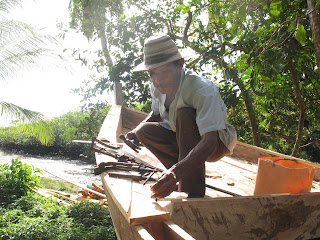
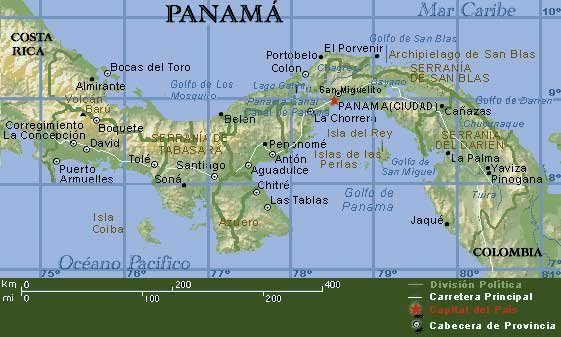
April and Kevin in Kuna Yala, the northeast coast of Panamá
Showing posts with label Island life. Show all posts

Sunday, June 28, 2009

Final Boat Update

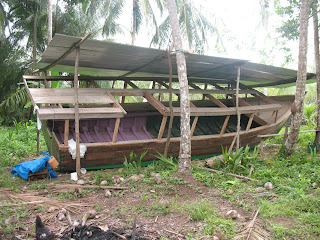
A few weeks ago, I thought I wouldn't have any more progress to report. They had righted the boat and put a "roof" over it of zinc panels. I thought that was to keep it drier during the rainy season than it would have been otherwise.

(Allie's boat under cover for the rainy season; it was perfectly upright originally, but they tilted it again when they continued working)

It turns out I was wrong. They covered it so they could keep it dry enough to work on. Pedro and a fellow from port applied fiberglass to the lower sides of the boat (a very smelly process) and then started to paint it. The fiberglass and resin/glue cost roughly $800; which is more than most folks on the island make in two or three months, so it took some budgeting and planning to purchase the materials and have them applied (labor is probably $8 to $10 a day as well, and probably took three to five days on a boat this size).

(Painting the boat after the application of fiberglass layers; five on the keel/bottom and three on the sides.)

Pedro achieves the very straight edge by tautly stretching a line of cord from the back to the front of the boat, and slowly painting and chatting.

(April helped out with the chatting part of the painting, which is a very common form of help)

Saturday, May 23, 2009

Boat Repair

Do you remember the boat that was in our house when we first visited in July 2007?

It was still there when we moved in in November 2007. It stayed for December...and January....and on and on. We got used to using it as a type of bench. Then April told the owner that she was going to move it...he just needed to say where to put it.

Then the first weekend of May 2008 (less than 2 weeks after April asking where to put it), we came home to find that the boat was no longer there. Our neighbor had finally moved it into his front yard. It stayed there for about a month, before moving into the Casa Comunal (a very similar design to our house, but much bigger) across the field. Over the course of the last year, they worked on it, practically taking it apart and expanding it into something larger. The finished boat was about 1 1/2 feet wider and a couple of feet longer than the original. They put fiberglass on it, and put it in the water around January of this year.

And the fiberglass separated.

So they pulled it out in the cove near our house, cut off the fiberglass, and put on a new layer (ouch, expensive mistake, since everyone would like to fiberglass their boats to make them last longer and float lighter, thus using less gas, but it isn't cheap).

Then they pushed it back into the water.

(Check out those long legs helping to push)

After cutting some lengths of a trash tree (grows really fast, dies fairly soon, and isn't good for anything other than making O2) to serve as rollers, they recruited a bunch of neighbors and kids to move it back into the water.


(Almost there, although if it were a really high tide, it would already be in the water)
Someone gets the job of running the logs around to the front once we've rolled off the back ones, since they haven't lined the entire length to the water.


(At last, it makes it into the water; it is one of the brighter boats in our community)
This time, the fiberglass held and the boat has been put to work fishing and transporting people and stuff. It is a bit larger than most of the boats folks use around the island, but makes for a nice ride to port, with the little casita to shelter from sun and rain.
We are seeing an increasing number of boats that are either all fiberglass ($$$$) or have a fiberglass layer on the bottom ($$). For those of you who remember Allie's boat that Pedro was building, it is still sitting pretty in his front yard waiting for the plata (money) to finish it.
The art of making and using an all wooden boat is not lost in our community, but in our two years here we have seen an acceleration of the change away from natural local materials. We have also seen at least one small boat handmade from a single log...but there are not that many big logs anymore to use this way. Things will always change, the changes just feel faster sometimes when you can actually see them in progress.

Saturday, March 28, 2009

Minute Man and the Milky Way

After April left on Sunday, I spent Monday, Tuesday, and Wednesday hiking around the island getting papers filled out for site development for a follow-on PCV, pasear-ing (just chatting) with folks after the health fair, and trying to find a ride out for Thursday. I was successful on the first two. But the only ride I heard about for Thursday was with Efrain, my original guia (guide), who lives on the far side of the island. Since it was about a two and a half hour hike to go see him, I called instead, but had to leave messages. I didn't hear anything until Wednesday evening around 6. Efrain was going out, leaving in the madrugada (middle of the night) with some family who was visiting (it is still summer/dry season here and school is still out), but was willing to swing by our house to pick me up. Around 4am he said. I had a ride!

So I got the house ready for leaving, putting the parts of the kitchen (which is outside) in the back room, pouring out the pee container, burning the toilet paper, and taking down all but one of the hammocks. I set the alarm for 3:36am, which would give me more than enough time to get dressed, drink a glass of water, grab some bread, tie up the trash bag to carry out, and sit in the hammock to await the sound of a boat (while Efrain may be fairly timely, we've learned to be patient awaiting rides out, especially in the madrugada; the hammocks go away in the morning). And I went to bed.

"¡KEVIN!"

Huh?

"¡KEVIN!, ¿esta listo?"

OH MY GOSH, I must not have heard my watch alarm! Nor my phone alarm?

"Si Efrain. Uno momento."

What time is it? Wait, it is 3:32am! He's early!

So I hopped up, pulled on my clothes, grabbed my bag, stuck the water filter in the back room, and left the trash and the hammock; Efrain was ready to get back in the boat. My watch alarm to wake up went off as we were pulling out of our cove. I felt like a Minute Man.

But a two hour ride to port starting at 3:30am can be beautiful. There are no lights along the Gulf (it is a RAMSAR Treaty Protected Wetlands Area) and the view of the stars can be amazing. Although there was a stretch where I thought at first that it must have been cloudy, since the stars were almost blurry and the background was greyer / less black. But over the course of the entire ride, that section of "clouds" never moved. I realized this was a different, early morning, section of the Milky Way from the more distinct stars-on-a-whiteish-background portion we can see in the evening, when we more commonly are out looking up at the stars. (My reaction reminded me of Barack Obama's similar description of watching what he initially thought were unmoving clouds over stars while in Kenya in Dreams From My Father, which I'd initially scoffed at, "knowing" what the clear whiter stretch of the evening night sky was.)

That amazing section of the Milky Way and the other constellations and the several shooting stars visible in the vast expanse of sky were also reflected on the mirror smooth water ahead of our wake. Despite the early hour, I kept my watch, like a Minute Man soldier of old, on the ever constant yet ever intriguing view of a clear star-filled night sky free of light pollution.

Sunday, March 22, 2009

New Latrine at the School

The Padres de Familia group at the school recently took the initiative to dig a new pit and build a new cement block latrine at the school. Here is the not-quite-finished result.


Here is why they needed to build it.


The old one was apparently 40 years old, built when the school was in 1967. Because there are fewer students today, they only built two stalls instead of three (one of the old ones was just a shower). Luckily, no one was inside when the old one collapsed. The guy on top is removing the screws from the old roof so they can put it on the new building.
A pretty impressive planning and implementation effort for the Padres de Familia, who didn't feel like waiting for MEDUCA (Ministry of Education) to help fix the issue.

Thursday, March 19, 2009

Boat Progress - Painting, roof, tools

If you've been waiting for an update on Pedro's progress constructing the boat, well, not too much has been happening lately. They are waiting on some more wood to dry we heard. But a few changes happened in the past few months. (BTW, this is a different Pedro from the cattleman who went to the demo farm with me.)


(Pedro working on the sides of the boat)

If you recall the last photo, there were still some boards missing on the sides. Now Pedro has put the sides together, along with most of the top.


(This is most of the tools he's using: a saw, a hammer, a plane, a couple of clamps)

Alex (who did go to the demo farm with me) is the one paying for the boat to be made, and he and his family have been a part of the process too.


(Alex, his wife, and daughter, painting the inside of the boat; supposedly they just didn't have enough of any one color to do it all.)

I can't figure out why they painted the floor, because if he is going to put cattle in it, normally there is a floor of boards over the bottom.

(The current state of the boat, for about a month now)

We'll have another post soon about work on other boats on the island, because the summer/dry season is clearly the time to work on boats.

Wednesday, March 11, 2009

Our new Solar Oven

Friends are a wonderful thing...even when they plot behind your back. Little did I know before Tabassum and Linda arrived for a Christmas time visit that they were plotting with our mutual friend Bill to haul a heavy gift to us.

Bill, who owns a business installing irrigation systems, did some work for one of the guys (I hope I got this story right) who works at Solar Household Energy (SHE), a 501(c)(3) not-for profit that makes solar ovens. Well, Bill was hooked with the idea of a solar oven that cooks using only the energy of the sun. He bought one and enjoyed using it.


Bill soon decided that we needed one and so sent us one via two petite couriers. (Linda and Tabassum were really looking forward to leaving that heavy stove at our house...little did they know that they would leave here with bags a little heavier than when they arrived. Thanks for hauling our beach glass collection home!) Due to good protective packaging and careful hauling, the stove arrived in excellent condition. We opened it Christmas day.


Well, I understand why Bill was hooked. It is a pretty cool stove, and works well with full sun. It is incredibly simple and easy to clean. I was also thrilled that I can use the pots as mixing bowls...something that I was lacking. They also serve well for overnight storage of food.


Why cook solar? The Solar Household Energy (SHE) webpage says:

Currently, more than half of the world’s population relies on biomass (wood, animal dung and crop residue) for cooking, according to the U.N.’s World Health Organization (WHO). This practice causes disease, economic hardship, and environmental degradation. Modern solar cooking ovens like SHE’s “HotPot” offer practical, affordable, long-term relief.


In our community here in Panamá there is evidence of families that suffer from smoke related illnesses. There is a high incidence of respritory illnesses and colds. A couple of the ladies that we work with have even been advised by their doctors that they should avoid cooking with leña (wood) because of the negative impacts of the smoke on their health.


Of course, we were excited to receive it...and so made bread with it the same day. The first 4 photos below are from our first attempt at bread. I made the dough for a white herbed onion and garlic bread. I covered the dough with oil and put it in the pot...


This is what the whole stove looks like, the mirrored surface makes understanding it's shape a bit more difficult.


Within half an hour of putting it in the sun the glass was steamed up and the pot was really warm to the touch.

The bread turned out really well. It had good flavor and a rich dense even texture. I think that it will work better to let the bread rise more by not pointing it directly into the sun at first. The only problem that I had is that the stove lid catches the evaporation and sends it back into the pot...which is a good thing if cooking soup, a stew, or roasting something, but when cooking bread resulted in a soggy bottom crust.


I also tried rolls...and put them in a bowl inside the pot as a measure of protection from the moisture. They were ok, I think that they overcooked as they were dry and heavy. I will have to try that again. But, they did raise well.


I also cooked a casserole (rice, mushroom soup, veggies, tuna, and a bit of leftover cheese on top) and that cooked wonderfully in about 3 hours. It was enough food for 2.5 meals for the two of us. Below are before and after cooking photos.


Baco's also gave this casserole a good flavor boost.


Other things that I have cooked?


  • rice (too sticky from long slow cooking),

  • eggs (hardboiled well without water),

  • brownies (my first failure as the sun clouded over about 45 min after putting out the stove...but I cooked them on the stove top as normal and did not mind the excuse to eat a little brownie batter)

  • Zucinni / pumpkin bread (done 3 times now and a big hit with everyone who trys it)

  • Water (heated to do laundry with hot water...best for the dirtiest clothing)

With direct hot sunlight things cook well, taking about 2 or 3 times as long as normal. This can be an issue if you need to go somewhere or the weather changes. Reheating foods is also possible and doesn't take terribly long. Wind, clouds and curious kids standing between it and the sun can all increase cooking time.


This stove offers a good alternative to fuel based cooking for some types of cooking. It is not a perfect alternative. Solar cooking is more suited to slow cooking foods and can not make fast cooking foods (can't fry with it for example). In our community here in Panama, this might mean that it would receive limited use...maybe for beans and soups and roasts, but it is too cool for frying and cooks rice so slowly that it is more sticky than most would like. It is not reasonable to think that people will change their traditional diet to use a new type of stove, when they still have access to the means to cook traditionally. In areas where the situation is more dire this stove would be more fully utilized out of necessity. Please do not interpret this to mean that my neighbors would not use it, rather it would be one of many cooking methods.


All in all, I am a fan of the solar stove and plan on continuing to try new foods. I particularly want to try to roast a whole chicken without oil or water like the directions book says you can...I think that that might just confirm my "wizard cooking abilities" in the minds of my nieghbors if it goes well. We like it so well that we plan on hauling it (even though it is HEAVY) to the next volunteer conference here in Panamá so other volunteers can see it too.


A big THANKS to Bill and his helpful couriers Linda and Tabassum for this wonderful and very appropriate gift. Our plan is to pass it along to another PVC when we finish here in Panamá so another volunteer (and their curious community) can enjoy it too.

Monday, March 9, 2009

Palm Wine

(Photos uploaded by April; text by Kevin)

There are lots of reasons to chop down a tree. Cut it into lumber. Make Firewood. Clear a field. Because it threatened to drop a branch on the house. Because it drops stinky fruit on our porch.

Recently we encountered a new reason: because it makes a vina de palma, or palm wine.


(April and Ancelmo at a felled palm; he will scoop the wine and fill that small container. It is hard to see the trunk of the tree for all of the fronds around it...but he is working with the trunk.)

On Ash Wednesday (in other words, the day after four days of Carnaval fun had finished), I was pasear-ing around the island to tell folks about a meeting on Saturday. My last stop was at Ancelmo and Paula's house. They had been our first host family on the island and are always glad to see us. This time, Ancelmo was even more amigable (friendly) than normal; for him Wednesday was the day to finish up anything (alcohol) that hadn't been consumed during the previous four days. After chatting for a bit, they asked if I wanted to see the vina.

Well, I wasn't sure what that was, but I agreed to follow them up into a field. They assured me that it was not that far...and sure enough we soon arrived at where they were making vina de palma and I finally understood. After realizing what it was we were after, and enjoying some good vina (not as much as Ancelmo), I agreed to bring April back the next day. These pictures are from that visit.

The palm (not all types of palms work for this; some are used for their fronds to make roofs, this one is used for wine) is cut down and a hole is cut in the side, near the former top of the tree. There are other countries where palm trees are tapped to make wine rather than cut down, but in the island these trees are basically weeds that are allowed to grow for a few years just so they can be cut to make wine.


(The hole in the side of the tree)

The sap continues to climb the tree for about ten days afterward, where it collects enough to empty the hole twice a day. The sap contains natural yeasts that start fermentation immediatly and naturally.


(Ancelmo scooping the vina from the hole)

The other option, besides scooping out all the vina into a container to bring back to the house, is to cut a reed that serves as a straw, and enjoy some vina right there in the midst of the long, dangerous thorns that cover the palm.


(Me following Ancelmo's directions to try some more, try some more)

So how does it taste? If you empty the hole, the next time it will have a very warm initial taste followed by an almost sweet vina. That was how it was the first afternoon I was there. Take a long sip, because while the first taste may be a shock, the rest is better.

But (possibly due to his enjoyment of other beverages earlier that day), they didn't bring the cup to scoop out the hole that first day, this left some of the wine fermenting for another 24 hours. So when we returned with April the next day, the vina had fermented a bit more, and was, as even Ancelmo put it, fuerte (strong).


(My reaction on day two shows the difference in flavor and strength)

To keep the sap flowing, after emptying the hole you need to carve off the upper-most layer of the heart of the palm. Like a Christmas tree, this keeps it from sealing over.


(Anclemo using his machete to scrape off the leading edge of the palm heart)

Then before you leave, the hole is re-covered with the chunks from cutting it, as well as some of the spikey palm fronds, to protect it from ants, bees, animals, dogs, horses, and neighbors.

(Ancelmo putting the frond over the chunks in the hole)

The day April and I visited, we didn't partake much of the vina, since it had developed such a strong flavor. But the first day, I'd been hiking and chatting for about four hours by the time I arrived there, and I was thristy. And Ancelmo kept saying, try some more, try some more. The sun was setting, and I needed to walk fast to get back at least to the sidewalk before it got too dark to go safely over the rocky trails.

But the sky and clouds were turning beautiful colors and we were hanging out in the middle of a field drinking from a recently cut palm tree. I just couldn't feel in a hurry to leave. Using a straw, I have no idea how much I sipped, but it wasn't too strong that day, and I made it home happy and safely.

Wednesday, February 4, 2009

Year end school party

At the end of the school year, which occurs down here in mid-December, just before the summer break, there is a party.

But it is more than just a party for the students. It is a party for the students, the teacher, and the madres and padres de familia (in essence, the PTA). This year, the students actually did some fund raising to help pay for the event, in the form of tumbulas, or raffel drawings. (Admittedly, similarly to in the states, most of the chances were purchased by the family, not by selling to neighbors and such, so the fund-raising burden was on the same audience.) The Padres de Familia (PdF) also had raised funds over the course of the year, including a chicken project (buy chicks, raise them, and sell them as 4-pound hens for about $1 to $1.50 a pound), and selling some teak wood planted on school property.

So what does all that fund-raising get you in a year end party?

Well there is the food: arroz con pollo (shredded chicken in flavored rice with olives, raisins, carrots, and other additions), ensalada papa (potato salad, with a pink or reddish color when made Panamanian style due to the beets they use), some bread (a rarity in our community), and the traditional Christmas foods of an apple and some grapes. They love apples but do not eat the pple skin...they bite off a chunk, chew until there is only skin and then spit out the skin.

Then there is a gift bag for all 21 students, with a toy and a Tshirt. And a gift for each parent, generally a nice shirt for the dads, and a fancy shirt, nightshirt or a cosmetic product for the moms.

And the piñata, full of confite (candies) and confetti.


(Swinging the bat at the snowman piñata; see the line of boys behind, ready to go)


(Sometimes a hit doesn't break the piñata but results in a few pieces flying out; despite the possibility of another swing with a metal bat just over their heads, the kids go diving to recover the candy; I'm not sure if the woman in yellow is a mom trying to protect them from getting hit, or trying to grab a piece too. April's comment- She is diving for candy...pretty sure.)

This year's piñata was a good one, that took a while to break. April took a video of them swinging, the handler pulling it out of reach, and then it finally breaking and the mad dash to grab as much candy as you can, children and adults alike. (But video is too big to upload, so we have no pictures of the final mad dash.) Everyone brings a plastic bag to carry it all home.


(The piñata handler in the back of the room, watching the swingers and pulling the rope to make them miss; when the piñata started leaking, he also decided to pull it up of reach or shake it to break it and get everything out)


(Afterward, the confetti is fun to play with; Roxana and Soray swept the floor not to clean up, but to toss it back on each other)

They also bring plastic bags to carry home the distribution of left over school food. The education ministry supplies the school with rice and beans and lentils for the school lunches that the moms cook. But the distribution sometimes lags, with the first batch of food not arriving until school has been in session for a few weeks, and the last with no time left for the kids to eat it all. So the parents divide it up amongst themselves, since it won't keep over the summer until school starts again in March.

The maestra (teacher) and Cecilia (one of our host family moms and the president of the PdF) and some of the other moms pulled out the 50-lb. bags of rice and set about evenly distributing them into the bags the parents had. It was a bit of a mob scene at times, despite knowing they would all get some, in part because they could leave once they got it. At one point, Cecilia winked at April and said, "Parace como Somalia, no?" ("Looks like Somalia, doesn't it?"). For a woman without a TV, who just gets the news from the radio, it was an interesting observation.


(Cecilia distributing beans; the source bag, on the ground, is marked with the Panama flag and the government name)


(Distributing beans, with everyone waiting in line)


Oh, and while we were waiting for whatever was the next step of the party, Kevin became the entertainment for some of the smaller kids with the You-Jump-I-Lift game. Considering how much taller he is than most Panamanians, it was a bit like flying and rather exciting for them. Luckily, one of the moms finally came over and told the kids in line (they cycled back into line numerous times, organizing themselves and encouraging in the more timid littler ones) that Kevin needed a break and this was the last time. :)


(The You-Jump-I-Lift game; some got the concept and timing better than others)


(Kevin lifting Bebo (José), but note the look of excitement on Carlito's face)

It a fun time for all, and a pleasant way to end the school year and calendar year.

Monday, January 19, 2009

Noah? No, uh, Pedro

Pedro is the resident boat builder on the island. He was recently hired by Alli, one of the few cattle farmers on the north side of the island, to construct a cattle boat. It will be large enough to carry about 10-12 cattle to port for sale. While it will likely look similar to the one that we seem to take rides on near Christmas time that don't make it to port without troubles (from last year, although April didn't mention running out of gas three times and not buying it for the return trip either, see http://ak-panama.blogspot.com/2007/12/all-i-want-for-christmas.html and another this year), we have faith that this boat will be good and the motor will behave better.

(This shot from the back end of the boat shows about a day of Pedro's work)

The wood was all cut from trees on the island and has been stacked up to finish drying in Alix's front yard for a month or so. To me, it seems Pedro is working quickly.


(About two weeks after the previous picture, Pedro had most of the sides in place by Christmas Day)

As we pass by on our way to the school, we'll snap more photos and provide updates on the progress of boat building on the island. I hope to get a picture of Pedro with his tools - all three or four of them, and none powered.

Wednesday, January 14, 2009

McDonalds Boat Ride

We needed to be out on the Monday before Christmas to pick up Linda and Tabassum. The only ride for sure was Friday. It was paid for by a political person to take kids (and their moms) to McDonalds. We figured it wasn't really supporting a political figure, since the coordinator had never mentioned which politician it was, so we took it.

First, we were on a big boat. There were about 40 people, counting moms and kids. We were going against the current and the wind, and figured it would take four hours to get to port, since it was only a 40-hp motor. But about 45 minutes from the island, the motor totally died. They tossed the anchor so we wouldn't drift back to our island. Luckily April had brought an UNO deck, and so she taught a bunch of the mom's how to play.
(April teaching UNO to moms - and some kids, some of whom had already learned from us - as we wait for another boat or motor help)
After about an hour or so, a police boat returned and took some of the folks to port, including the coordinator of the trip. Then about half an hour later, a couple of fishermen from an island further south stopped by. They were headed to port and after chatting for a bit, agreed to take some of us, including April and I and our bags. They had the same size motor we'd started with, but a smaller, fiberglass, boat, so it was faster.


(Watching our first boat recede behind our new fast ride. One tip of our island is visible behind the boat.)

We moved along rapidly in boat number two. Then we saw the coordinator heading back south in an even faster boat, with a shade roof.

(Sisters Dianeth and Leidys on boat number two, the fast one)

Then boat number two ran out of gas. We drifted to the shore and waited. April asked if they ran out of gas because they had the added weight of six extra people. They said no, they wouldn't have made it to port anyway.

Ironically, the "taxi" boat guy we use sometimes happened by and sold a bit of fuel to the fishermen. So we started off again after only a twenty minute delay.

But we were within site of port when we spotted the faster boat gaining on us from behind.

(Our kind fishermen - you can tell we are close to port, they have their PFDs on - watching the rest of the kids and moms race up towards us)

Sure enough, just as we pulled into port proper, to the delight of all the kids who'd been left behind twice, the faster boat passed us. There was lots of laughing and pointing. But we'd all made it, and sure enough, it took four hours. Just not how we'd expected. And we still haven't figured out what happened to the first boat.

Friday, January 9, 2009

More Jack'o'lantern pictures

As you'll see, once April returned the day after we carved the zapallo jack-o'-lantern, it was no longer the scariest looking thing on the porch.


(Here is the jack-o'-lantern by itself.)


(Then April asked the kids to make faces.)


(They really understood making faces once they saw the picture of my face.)


(Then April made faces with the kids, but the parents started to join in too.)


(So April got a couple of the moms to make bruja (witch) faces, and they quite literaly let their hair down....)


It definately seems we started something they'll continue after we leave. And they probably won't grow zapallo just to carve faces either; Maria made zapallo bread with the jack-o'-lantern the next day, and it was quite yummy.

Sunday, January 4, 2009

Walking on Water, to church

On 12 December, Kevin went to a Patronales (patron saint) mass at a community on the western coast of our gulf. It was at low tide. As you can see, a bit too low for the boat.

(Eduardo, sporting church clothes and a Panama hat, walking our ride over a sand bank)

Eduardo hopped out to walk us through the parts where the motor couldn't run because it would hit the sandy bottom. You can see our island behind us, and we have about half that distance yet to go to the coast. We walked for a total of about fifteen minutes to get over the various sand bars.

On days when the tide is great, the highs are very high and the lows are very low. This was such a day. When the tides are very small, the highs can be four feet less than on the big days, and the lows four feet greater than the very lows. So sometimes spots can be passable at low tide (when the tides are small), and sometimes not. You just have to know the tides, read your tide table, or be willing to try to walk on water.

Wednesday, December 31, 2008

Carving the first Jack-o'-Lantern

Yes, Halloween was well past, and Thanksgiving had come and gone. Christmas might have been fast approaching even. But that did not dampen the enthusiasm of our neighbors for carving their first ever jack-o'-lantern, perhaps because the idea is very similar to their burning of a New Year's muñeca (life-sized doll). (We'll post more about that when we come back out of site after New Year's, or you can check out our post from last year's holidays at http://ak-panama.blogspot.com/2008/01/how-we-celebrated-holidays-2007.html.)

It was while April was off-island, and I was solito y llorando (alone and crying), as our neighbors love to joke, so when I stopped by to chat and asked if they were interested in carving a jack-o'-lantern, faces lit up like there was a candle inside. They were familiar with the look from watching the movie Halloween over the years (I can't imagine being 10 or 12 and watching Halloween on a 13" black&white TV without lights and then going to bed in the pitch black) but had never seen a carving done.

The first step was to draw "scary faces". I brought up paper and markers, with a little encouragement to change the white page to something scary, they started trying out designs, and pretty soon we had several good sets of flaming eyes and gnashing teeth.


(Milagros, Leidys, and Eneida - Milagros' mom -, drawing "scary faces" for consideration for carving)

Since we didn't have a pumpkin, we used a zapallo, which is a pumpkin-like squash with slightly tougher meat and a more ridged skin, but very similar - and roastable - seeds. Once the kids (and adults) had finished drawing, the top was cut off the zapallo, and volunteers were recruited to clear out the guts (which come out much easier than a pumpkin, it seems).

(Leidys, Noritza, and Dianeth cleaning out the inside of the zapallo. The first reaction: "wow that's cold!")

Next they picked what they wanted to carve and we drew it on the zapallo. They selected our neighbor mom Eneida to wield the knife, and she did a rapid and detailed job of carving the face.

(Panamanians like Eneida are adept at knife work, perhaps from gutting fish and chickens for meals on a regular basis)

Then it was time to light the candle. Even though it was still light outside, everyone was excited to watch.

(Ceremonial first lighting of the jack-o'-lantern)

Here is the carved result, with Elvis and Eneida for comparison purposes. We'll put up some pictures taken in the dark, after April returned, when we come out next.

(For the first time ever carving a jack-o'-lantern, it was a pretty scary result!)