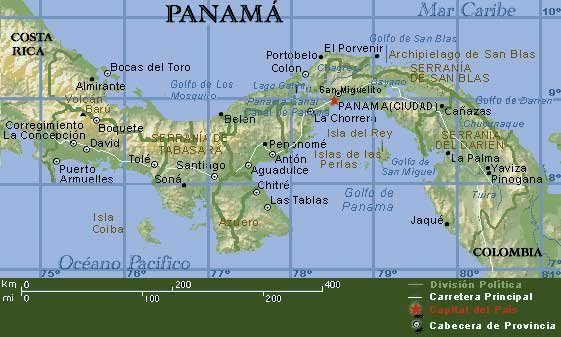
April and Kevin in Kuna Yala, the northeast coast of Panamá
Showing posts with label Photos. Show all posts

Sunday, June 28, 2009

Final Boat Update

A few weeks ago, I thought I wouldn't have any more progress to report. They had righted the boat and put a "roof" over it of zinc panels. I thought that was to keep it drier during the rainy season than it would have been otherwise.

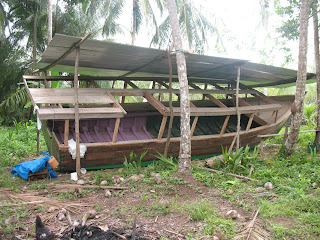
(Allie's boat under cover for the rainy season; it was perfectly upright originally, but they tilted it again when they continued working)

It turns out I was wrong. They covered it so they could keep it dry enough to work on. Pedro and a fellow from port applied fiberglass to the lower sides of the boat (a very smelly process) and then started to paint it. The fiberglass and resin/glue cost roughly $800; which is more than most folks on the island make in two or three months, so it took some budgeting and planning to purchase the materials and have them applied (labor is probably $8 to $10 a day as well, and probably took three to five days on a boat this size).

(Painting the boat after the application of fiberglass layers; five on the keel/bottom and three on the sides.)

Pedro achieves the very straight edge by tautly stretching a line of cord from the back to the front of the boat, and slowly painting and chatting.

(April helped out with the chatting part of the painting, which is a very common form of help)

Wednesday, June 24, 2009

UFO in Panama!

Many of you reading this already know that I am a bit nerdy at times....I might as well admit it to the rest of you because you will figure it soon enough. But really, I am also a fairly normal person too.

So it all started last year...the observation of one of the coolest bugs that I have ever seen. Panama has some great wildlife to observe...but I doubt that many people have visited to see the lightning bugs. Yes, lightning bugs (or fireflys to some) do exist, they are not just a Disney or Hollywood creation as my fellow PCVs from the west coast thought...poor souls who grew up deprived of lightning bug wonders.

Here on the island we have "normal" lightning bugs, a little bit smaller than those in the states and sometimes a bit more sychronized (video of sycronized lightning bugs)....but basically the same. We also have two other types of lightning bugs. My nerdy self just wiggled in excitement at the diverisity of it all.

The first one I noticed had a big bright orange light...its light was about the size of my thumbnail!!! I only got to see it flying as it tended to fly faster and higher than the "normal" lightning bugs. It also seemed to flash with a bit more frequency and when it flashed its light was frequently a sequence of flashes, not just an on and off again. I was facinated by these bigger orange lightning bugs, but they seemed too fast for me to catch, especially since they seemed to like the woods around our house more than the fields...making running after them much more difficult. So I just admired from afar waiting for the day that one would make the mistake to cross my path.

There was also a lightning bug who had the normal green/yellow color to its flash. I only knew that it was a different type at first because the strength of the flash was so strong. It strobed with the power (and sometimes the speed too) of a weak camera flash!! One night we had one of the strong flashers in our bed room, so I got out of the mosquito net to see what it looked like. It was a fairly non-descript beetle...a bit bigger (about 2x the size) than of a normal lightning bug. Pretty cool, not as common as the other two...but very powerful flash!

So just imagine my gleeful nerdyness when I looked out the "window" (fancy word for the space where we made the bamboo wall in the kitchen short to keep the view) and saw two bright green lights at the edge of the woods near the house. They looked like green LED lights. So of course I went to look thinking that it would likely be two bugs...and was very excited to find one bigger beetle with two lights.


This is what the lights looked like. He could control the brightness of the light to some extent...it could be very bright or dim...and powered up and down like it was on a dimmer switch. Very cool.

This is what he looked like under a light. Pretty non-discript in his color and markings.
This is to give you a sense of scale and size. He crawled all over my hand for a few minutes...turning his lights on and off. If touched the lights turned on very bright. I was finally tired of bothering him when he decided to fly away...and shocked the heck out of me...as he took off and flew away the underside of his abdomen light up ORANGE!! I was thrilled!!
Lucky for me, he did not fly far and I was able to chase him down and look at him again. I looked at his underside...but there was no way to tell that he had an orange light under there...it must be covered when at rest. But each time he prepared to fly the orange light would flare up on the underside. After much patience on my part and a hand over top of him to keep him from getting far I managed to get a photo of both lights. The orange light is just starting up in this photo.
It turns out, I think, that he is the same lightning bug that I have been admiring flying around our house. The one that was brighter, orange and tended to fly faster and higher than the "normal" lightning bugs. I had wanted to see one up close and never managed to catch one until now...and even then it was a suprise!
Below is a brief video of the lightning bug taken by Kevin. If you are very observant you can see the orange light start up in the moment before the beetle escapes us photographers with a flying get-away. Watch carefully...when he goes it is FAST!


In my wanderings around the web I visited the Wikipedia site on fireflies and found out that sycronization of flashing is common in some areas...
"In the United States, one of the most famous sightings of fireflies blinking in unison occurs annually near Elkmont, Tennessee in the Great Smoky Mountains during the first weeks of June. Congaree National Park in South Carolina is another host to this phenomenon."
Guess I know what I want to see if I can ever manage to hit Tennessee in early June!
I continue to watch the lightning bugs in facination. There are some really cool insects here to see...and to photograph. I would like to thank my faithful and patient lighting aide Kevin for his help to photograph the bugs that visit us. Some people would think I am just strange, but he just smiles and holds the flashlights steady.

Friday, June 19, 2009

Grand Opening for the Island Library

It happened!

La Biblioteca (the library) is open! As you may recall, the community had made plans to make bookcases and organize books. Well, the chainsaw never worked out (due to a lack of gas and/or oil and/or machine), and bookshelves never got built. But, there was a spare bookcase from the kitchen in the school, and they decided it would work fine for the library and they would replace it when the chainsaw happened.

So, as scheduled, on 5 June Cecilia and her husband Eduardo brought their boat to our cove and we loaded up the six "Panama" bags we had filled with the books stored at our house and hauled them to the school. We organized them that day and the next with Cecilia and Maria Luisa into little kids (thick pages), easy reads, medium reads, chapter books, Panama information, science and education books, health books, books about adolescence, and English or Spanish books. We confirmed the plans for the checkout system and library hours. They talked to everyone about the Grand Opening on Tuesday, 9 June, and we actually left for the weekend, arriving back on Tuesday morning.

It turned out that Cecilia and Maria Luisa, together with the maestra, were up to a bit more than the Grand Opening of the Library. The maestra had organized all the kids in the school to sing a song or recite a poem for us, and they had a going-away lunch.

Then we had everyone wash their hands (manos limpias para los libros - clean hands for the books) and we held a story time to celebrate. We had all the kids, plus some younger siblings, and numerous parents. I read one of the Guillermo Gusano / William Worm books that the kids have enjoyed. I think it was a good example for the parents of how to read to the kids.

Then April went over the rules of the library and how to treat books well so they last. (And to think, I was librarian's child. :)
(April reviewing the rules of the library, on the whiteboard and posted on the wall. Together with a map of the world - we later added a map of the Gulf of Montijo and one of the island - it looks pretty official. The books nearly fill the bookcase already; they are planning on making another one.)

After the rules, April read them a book we hadn't read in nearly exactly a year, Donde Viven Los Monstruos.
(April with a very attentive crowd of listeners as Max sails back home)

When the wild rumpus started, April shocked them to their feet to dance around, while I joined in banging on a plastic bucket. They thoroughly enjoyed story time, and hopefully Cecilia, who will host the Wednesday Library Hours with Story Time, will carry on the enjoyment. (Maria Luisa will hold Sunday Library Hours.)

But while we do hope Story Time continues, one of our main goals is to encourage kids and adults to read in general. We hope to have something for everyone.
(Rubiel, Carlito, and Kiko reading, while Roxanna and Soray look at books and talk with April)
Thus, this picture is one of the ones we enjoyed the most. These three boys all clambored to find a small book and sat down to read it. Kiko lives north of us and had been by our house regularly on his way home from school to ask for a book to read, and searched out his favorites. Rubiel lives on the south of the island and Carlos near the school, so they had not read any of the books before, and enjoyed discovering the options. I have faith that they will continue to read in the future.
So what came of the donations, which were originally intended for sealable boxes and desecant packs? Since the community decided the books would be more accessable on a bookcase, and donated the bookcase, April searched around online and found another addition to the library that they had wanted: an encyclopedia, to support homework projects and learning. She found one from Encyclopedea Brittanica for $250 (plus $50 S&H once we got an Embassy address; originally, to ship to Panama was $250 as well!) with 20 volumes, aimed at the middle school age range, so it should provide as much as they need. We just spent the rest of the money yesterday at Hombre de la Mancha, one of the few bookstores in Panama (the name comes from Don Quixote, not only one of the greatest Spanish-language novels, but an appropriate label for the jousting at windmills that is selling books in Panama), picking up the fourth Harry Potter, a set of 12 books on nature, the world, and science, and other kids books. In total, the library now has nearly 400 books! Thanks to all of you who shared your love of reading and your willingness to help with our community members!

Wednesday, June 17, 2009

Campaign Signs

I know the election is over, but here are some photos of campaign signs.

("Chalo" is running for Alcalde, or mayor, of Santiago. Because he is the PRD candidate, he is in the first position on the ballot, thus the "1" with a checkmark. His suplente, or backup, is also listed. And the presidential logo for Bablina/Navarro 09 is included, along with the name and photo of Ruben de Leon for Diputado, which is more or less a congressman.)

Often, utility poles will be utilized by all the parties.

(This pole has a Molirena flag on top, then a Union Patriotica poster for Diputado - which also includes the presidential alliance with Martinelli of Cambio Democratico -, then off the side a PRD flag, a Cambio Democratico poster for Alcalde, and then a PRD poster. The PRD poster says Vota PRD and Vota Plancha, which means vote the party, and shows the Presidential candidate, the Diputado, the Alcalde, and the Representante. There is a "1" on the side, just in case you forgot which spot PRD holds on the ballots.)

Monday, June 15, 2009

Pressing Sugar

Back in April, just after the All Volunteer Conference, we went to visit another volunteer who lives near Chitre, where AVC was held. While there, some folks in the community were pressing sugar cane.

Sugar cane is pretty much a grass that can be grown one little plot in your yard, or in massive fields. The companies burn the fields to get the scratchy leaves off before the workers go through and cut it (so they end up sooty and blackened, but not scratched), and you'll see heavily weighted trucks carrying stacks of the about 8-foot long, 2-inch across stalks to the factories, where it is processed.

But small farmers do it on a smaller scale. They load the cane into horse-drawn carts and haul it to the trapichi, which is a horse (or person) powered press. There, each stalk is passed through twice to squeeze out the sugar juice.

(Jon and April watching the horse and farmer press cane; the juice drains out onto the metal ramp which sends it to a filter to remove chunks and then drip into the barrel)

Once the juice is squeezed out, it is heated / simmered over several days to concentrate it. Huge metal bowls are used to the process. This farmer had his built into the stove for the process.


(The bowl of sugar cane juice concentrating. The stick has a large strainer bowl on it for scooping out the concentrate.)

His stove was almost like the Estufa Lorenas, in that it concentrated the heat, thus using less firewood. The mouth of this stove is an old wheel rim.

(The stove mouth. The barrels hold processed sugar juice; buyers will pay $50 for the barrel, but then probably sell the contents piecemeal in town for $100)


Of course, there are other kinds of sugar and honey you can press. :) April and I, dressed up to go to a Samy y Sandra Sandoval concert the next night at the International Fair of the Azuero (the Azuero is the eastern side of the big peninsula on the south of Panama, containing the provinces of Herrera and Los Santos, and is famous for its "typical" Panamanian culture). Samy y Sandra's grandmother lives in the community where we saw the cane being pressed.


Saturday, June 13, 2009

Some Food Photo Updates

Back at Easter, several folks brought us traditional foods. These included: a cocado, which is a mix of shaved coconut and raspadura, a cake of raw sugar cane sugar; a sweetened yuca mash (yuca is a very starchy root crop); and balos, which are corn flour mash, slightly sweetened, wrapped in a corn leave or husk.

(cocado, yuca, and balo)

Last week, April returned from Isla Coiba (it went well, look for a summary and photos -snorkeling, crocodiles, the penal colony- in about a week, when we get out again and she has computer time) with a sport fisherman, who offered her a ride back to our island (he was going past on the way to port) as long as she was willing to go fishing for an hour or two first. They caught a 50-lb fish they said was wahoo(sp?), but I'm not sure if that is the same as wahoo in English.

(April's nice doctor from Panama City who offered a ride back from Isla Coiba; he goes sport fishing about once a month for a couple of days to fill his freezer)

They immediately fileted it and stuck the ziplocs in a cooler, and when she got out, they gave her a bag with probably 8-lbs of two-inch thick slabs of fish. We shared some with our neighbors (the first time we've ever been able to give them fish) and cooked the rest with garlic and olive oil as massive steaks (except one we blackened with Phillips Blackening Seasoning; thanks Kristin).


(Cooking three of our massive fish steaks)

Monday, June 8, 2009

Vagaina Monologues

A couple of months ago, two volunteers in our region, Teri and Cassie, used the same funding source we used for our Health Fair to support the Theatre department at the Santiago branch of the Universidad Panama in staging Los Monologos de la Vagina (The Vagaina Monologues). In addition to the play, which was attended by over 300 people on its one night showing, they organized a day of charlas (discussions) for about 30 community members from PCVs' communities. The charlas, on AIDS and domestic violence issues, were led by Panamanians from Mides (Ministry of Social Development) and APLAFA (sort of like a Planned Parenthood maybe?) who are very enthusiastic about helping stop the spread of AIDS and ending domestic violence.


Five women went from our community to both the day of charlas and the play, and then spent the night in a hotel in Santiago. For all of them, it was their first time going to the theatre, and may have been their first night in a hotel. They certainly enjoyed themselves both at the play and with the night away (even if their rooms didn't have TV or A/C, they did have lights and a shower and bathroom).


(Maria Ester, Marlina, Ilsa, Yadira, and Magda, at Los Monologos de la Vagina, as evidenced by the playbill in Maria Ester's hand)

It took a lot of walking and talking to get those five (it was supposed to be six). Initially, we chatted with Cecilia and Maria Luisa (who would have loved to have gone, but felt that others would find greater benefit from attending) about who to ask. They recommended women they thought would be willing to talk about what they heard and/or who faced domestic violence. They selected women from all parts of the island, so that each community would have someone who had experienced the charlas and show. Then I walked around the island, visiting just about every house to deliver an open invitation to all the women on the island to the show, and a special invitation to the selected women for the full day and the night in the hotel.
I received a lot of interest (the name alone makes people take notice), and several of the women immediately said yes they would accept. There were some logistical questions (at one point, I thought I might be babysitting a two-and-a-half year-old all day, but evidently she stayed with a friend or relative) about the event, but with April in Panama City, I think any trickier questions about the topic weren't addressed to me. But when I returned a few days later to confirm their attendance, two backed out. It may have been due to child care concerns, or fears of spending a night out in the city, or it might have been a disapproving husband. Whatever the reason, I ran around to talk with our backups (two kids got colds and moms were unwilling to leave them with relatives; so they said) and called Maria Luisa and Cecilia. I also coordinated with Israel, the corregidor, to use the community boat to take us to port. As we left at dawn that morning to go around the island and pick everyone up, I wondered how many would actually be ready and going. I was pleasantly surprised.
We arrived at port early enough that we didn't need to go straight to the charlas, so I gave each of them their bus fare and told them we'd meet at the terminal at 8:45 to go to the APLAFA offices. When I walked up at 8:40, expecting to wait for them, all five were there, wondering why I was late! Then, instead of taking a taxi, Marlina said they'd walk, since she knew where it was and it wasn't far. I am constantly pleasantly surprised.
They were a bit surprised when I introduced them to Cassie, Teri, and the others leading the charlas and then started to leave; clearly they hadn't anticipated being left "alone". But when I came back at the end of the day, they were a happily integrated part of the class. The only other confusion came when we checked into the hotel. In addition to their three rooms, through the grant, I had made a separate reservation for April and I. But I don't think they realized that, and they were concerned about which one of them was going to have to share a room with me (five of them plus me, with three rooms, meant two people per room). They laughed once they realized the only question was which of them had to sleep alone.
Everyone had a few hours to get made up to go out, and then we headed to the theatre. When the play started, they initially checked with us for our reactions, but soon they were absorbed in laughing along with the rest of the crowd. They clearly had an exciting night, and from conversations with others on the island, they've been sharing their experiences and the fun. Thank you to Cassie and Teri for putting so much effort into making both the day and the play happen.
One other photo from that night:
(Us with the women from the island at the theatre; I don't usually see it when just chatting with them, but every so often, something points out to me that I am a bit taller than most of the folks here.)

Saturday, May 23, 2009

Boat Repair

Do you remember the boat that was in our house when we first visited in July 2007?

It was still there when we moved in in November 2007. It stayed for December...and January....and on and on. We got used to using it as a type of bench. Then April told the owner that she was going to move it...he just needed to say where to put it.

Then the first weekend of May 2008 (less than 2 weeks after April asking where to put it), we came home to find that the boat was no longer there. Our neighbor had finally moved it into his front yard. It stayed there for about a month, before moving into the Casa Comunal (a very similar design to our house, but much bigger) across the field. Over the course of the last year, they worked on it, practically taking it apart and expanding it into something larger. The finished boat was about 1 1/2 feet wider and a couple of feet longer than the original. They put fiberglass on it, and put it in the water around January of this year.

And the fiberglass separated.

So they pulled it out in the cove near our house, cut off the fiberglass, and put on a new layer (ouch, expensive mistake, since everyone would like to fiberglass their boats to make them last longer and float lighter, thus using less gas, but it isn't cheap).

Then they pushed it back into the water.

(Check out those long legs helping to push)

After cutting some lengths of a trash tree (grows really fast, dies fairly soon, and isn't good for anything other than making O2) to serve as rollers, they recruited a bunch of neighbors and kids to move it back into the water.


(Almost there, although if it were a really high tide, it would already be in the water)
Someone gets the job of running the logs around to the front once we've rolled off the back ones, since they haven't lined the entire length to the water.


(At last, it makes it into the water; it is one of the brighter boats in our community)
This time, the fiberglass held and the boat has been put to work fishing and transporting people and stuff. It is a bit larger than most of the boats folks use around the island, but makes for a nice ride to port, with the little casita to shelter from sun and rain.
We are seeing an increasing number of boats that are either all fiberglass ($$$$) or have a fiberglass layer on the bottom ($$). For those of you who remember Allie's boat that Pedro was building, it is still sitting pretty in his front yard waiting for the plata (money) to finish it.
The art of making and using an all wooden boat is not lost in our community, but in our two years here we have seen an acceleration of the change away from natural local materials. We have also seen at least one small boat handmade from a single log...but there are not that many big logs anymore to use this way. Things will always change, the changes just feel faster sometimes when you can actually see them in progress.

Wednesday, May 20, 2009

Money in Panama

The money in Panama could be pretty familiar to anyone coming to visit from the United States. That is because the "Balboa" is their name for the Dollar (and is also the name of a popular beer); the balboa has been tied to the dollar since its inception in 1904 after Panama's Independance from Columbia (wikipedia info link), and currently, the paper money is all US Dollars, although stores often use the "B/." symbol instead of the "$".


But while Panama uses US coins, there are also Panamanian versions of the coins as well, and the peso (50-cent piece) is actually used with some frequency. All the coins have the same composition as their US counterparts. I have not been able to figure out yet where their coins are minted however. And they do not seem to mint every year. I have found quarters, dimes, nickels, and pennies from 1996 (when the shields got smaller and other design changes were made) and 2001 for example, but nothing in between and only quarters since, with 2003, 2005, and 2008 versions, each with a different design. As they are the same size and have the same value as their US versions, you'd have no trouble spending Panamanian coins in the United States.


(From the top, clockwise: un centavo, un peso, una quara, un real, y diez centavos)


In recent years, the US Mint has begun a program of changing the obverse or reverse of US coins, making your pocket change much more interesting to look at and much more popular with coin collectors, who now try to hoard a copy of each style. Panama has been making small changes for years. Here are some of the versions I've collected in our time here.


Similar to in the states, one cent is called un centavo. But not a "penny".


(One cent pieces, with various front images; Urraca is a historical/mythological freedom fighter, who led the indigenous against the consquitadors in the 16th century)

The five cent piece in Panama is an integral part of the monetary system. Instead of a "nickel", it is called un real. And many items are commonly priced in reales. For instance, if you buy a soda for 20 cents, the shopkeeper will likely say, "cuatro reales", or "four nickels". This is true at least up to items that cost a dollar. So something that costs 75 cents would be "quince reales" or "fifteen nickels", not "setenta-cinco centavos".


(These five cent pieces sometimes have the shield, sometimes the face of Sara Sotillo, a Panamanian educator born around 1900 and instrumental in the development of teachers rights and responsibilities.)


You'll have to refer to the picture above of all the coins to judge the size, but Panamanian ten cent pieces (un decimo de balboa) are the same smallness as US dimes and are probably the most boring of Panamanian coins.

(Panamanian ten cent pieces don't have their own name, like "dime". These two reverses show two shield designs, the newer slightly smaller.)

To me, the 25-cent piece is the most dynamic. Here is the obverse (the Balboa profile) and five of the six reverse designs I have seen (I was missing the Childrens' Hospital, the newest design, that day).

(Panamanian Quarters, with from top left, the original shield design (at least 1966 to 1993), the smaller shield design without bottom fronds (1996 and 2001), the Panama Vieja tower (2003), the Puente del Rey (2005), and the Protégete Mujer (2008) with a Protect Women ribbon.)

While not as changing as the quarters, the peso, or 50-cent piece, is really neat mainly because they actually use it here in Panama. I have gotten one as change numerous times. While the coin holders that the bus drivers and ayudantes use do not have a space for them, they are not at all averse to getting or giving them, and toss them in a box to hold them.


(Half dollars, or medio balboas)
So, if you decide to visit Panama, you'll have no trouble spending your US money, and you'll have something interesting to bring back and share with the grandkids or just the clerk at the local tienda. :)
I did spend a US "gold" presidential dollar at a tienda on the island. One was willing to take it, probably more as an interest item, while another didn't want it and wanted paper. That is one coin that doesn't have a large circulation here. Of course, it doesn't up in the US either. :)

Monday, May 11, 2009

Panama National Election 2009

"Change" seems to be a global presidential theme. On 3 May 2009, Panama held their once-every-five-years elections, and Ricardo Martinelli (millionaire owner of the Super99 chain of supermarkets here in Panama), who started his own Cambio Democratico (Democratic Change) party, defeated Balbina Herrera, of the PRD party, a long standing party which currently holds office with Martin Torrijos. (Presidential candidates can not succeed themselves, so Torrijos did not run.)

But while the global themes of campaigns were familiar to the local campesinos (countrymen) in our area (we were often asked about Barack Obama, who did we vote for, and the similarity in themes between Obama and Martinelli), elections in Panama are much more of a local event. Be sure to watch the video at the bottom of this post.

As I said, elections are held every five years. At that time, citizens vote for Presidente, Diputado, Alcalde, and Representante. The Diputado is like a Representative in the US, serving at the national assembly level. The Alcalde is like a mayor or county executive. And the Representante is in charge of the local level issues (such as attracting the government funding to accomplish things like the solar panels all the houses have in our community, or the sidewalk constructed last year). He (or she; we had two female and two male candidates this year) is generally the first person residents ask when they need help with a project, need building supplies to improve their house, or need a new battery for their solar panel.

So over the past year, newspapers, TV, and radio were covered with ads for candidates (many analysts said that Martinelli could sink so much of his own money into the campaign that it greatly changed the dynamic and methods compared to previous campaigns). Other popular advertising methods include Tshirts, hats, and flags, as well as banners on the street lights, posts and trees. These banners often indicated who to vote for at all four levels. We even had a banner appear on the island that listed PRD candidates for Presidente, Diputado, Alcalde, and the local Representante (sorry, I didn't get a picture). When you see the ballots below, you'll understand how they can indicate who to vote for. But all organized events and paid advertising had to end by midnight on Thursday, 30 April. This was rather nice, as it provided a three day respite before the election. (The sale of alcohol was prohibited in this time period as well, so you couldn't be drunk the day of the election. Unless you made your own.)

El Dia de la Votación was Sunday, 3 May. And it is an event. Many folks are still registered to vote where they grew up, so although we have only about 150ish adults on the island, there were 265 votes cast in each race. (The influence of "outsiders" was greatly discussed, since they aren't really affected by the vote they cast for Representante, which to most of our neighbors, was the most important race.) Each of the four candidates for Representante provided a number of boat rides from port to the island in the days prior, and food the day of. Why food? Because everyone goes to the school to vote (polls opened at 7am) and then hangs out for the day, chatting with friends, etc, and awaiting the close of the polls at 4pm. At which time, the counting begins.

The voting is held in the school, with three members of the Tribunal Electoral (the election board) and one policeman to ensure the security of the process. (There is no vote by mail, or absentee voting, so those four could only vote for Presidente. An odd twist to service towards voting.) On the wall outside the voting room, they pasted instructions on how to vote and sample ballots.

(Fairly simple instructions on how to obtain your ballots - you need your ID card - then how to mark them, and finally how to cast them in their appropriate box.)


(No cameras, video cameras, or cell phones allowed inside the voting room.)


There is a separate ballot for each race. Each ballot has its own color coding to facilitate the process.

(The blue Presidential ballot, with pictures and names of candidates with party names and flags. )
There were EIGHT parties early on in the race. As time passed, alliances were formed that generally held at the lower levels as well. In a drawing of lots, the order of the parties on the ballots was established. PRD drew 1 (the red, white, and blue striped flag) and Cambio Democratico drew 5 (the green and pink "CD" flag). If you wonder why several of the photos and names look similar, that is because PRD formed alliances with Partido Popular (2, green star on blue flag) and Partido Liberal (6, red/white/red striped flag), and CD built alliances with Molirena (3, red and yellow triangles flag, with a red rooster), Partido Panamanista (4, purple/yellow/red flag), and Union Patriotica (7, red with orange stripe flag). A former president formed his own party, something like Vanguard of the Moral Front, and was spot 8 (of the 269 votes in our island, he received 2 sympathy votes from folks who apparently knew Martinelli would win and didn't want the guy to get nothing).
So if you wanted to vote for Martinelli, but were really a fan of the Molirena party instead of Cambio Democratico, you could cast your vote in spot 3, instead of spot 5. Thus your party (Molirena) was credited with bringing support to the alliance, and in the total count, Martinelli got your vote. Then (so goes the idea), when he is president, he will support your party's desires as well and reward your party bosses for the votes they brought to his election.

(The orange Diputado ballot. The pictures and names are smaller, and there are three "open" positions for anyone running as an independant. But the party flags and numbers remain the same.)

By the level of the Diputado ballot, some of the Presidential alliances had broken, and parties were running competing candidates.

(The pink Alcalde ballot. Molirena, 3, did not have an Alcalde candidate or alliance. The blue stamps indicate that this ballot has been nulled, so people can look at it outside of the voting room.)

All of the parties were allowed to have an observer in the voting room. Four of the parties did on our island, and the observers were residents of the island. Each one had a full list of the voting roster (a book with the name, picture, and ID number of each person registered to vote in that voting location). They watched from 7am until the counting ended, about 11pm, and ensured ballots were cast correctly, without coercion, and counted correctly. We did have one blind man vote (he does not live on the island, but I think grew up here; we have seen him before) and he was assisted by someone to mark his ballots, fold them (into quarters) and drop each one into the appropriate cardboard box, one for each race, with the appropriate color across the top.

(Our race for Representante. There were four candidates.)
"Chayo" ran on PRD (1), aligned with Liberal (6); he actually lives off-island, although he has a house in the south and is the brother of several residents. Popular (2) and Vanguard (8), did not have candidates or alliances at this level. Efrain Miranda (the Representante for the past 20 years, or since the new government process was instituted after Noriega's removal by the US and George Bush Sr) ran on Molirena (3), aligned with Panamanista (4). Paula (our first host mom on the island) ran on Cambio Democratico (5), aligned with Union Patriotica (7). We also had one Independant, Vielka, running alone in the pale blue 9 spot; she also lives off island but has a house in the south and family.
At 4:11pm, the workers from the Tribunal Electoral officially closed the voting and taped the boxes closed. The policeman entered the room to ensure the boxes were not messed with. The officials demonstrated all the remaining, unused, ballots to the observers, and then all seven of them walked outside and burned them (so no one could cast an extra ballot). Then they opened the box of Presidential ballots and counted them all out onto the table. 269, which is how many their records showed had voted that day (265 local, plus the three workers and policeman). Then they returned all the ballots to the box. They taped large sheets of paper on the wall, one for each party, each sheet with 20 rows of 15, to record the counting. Then one worker pulled out a ballot, determined how it had been voted, announced it to the crowd (while the party observers were in the room, interested community members crowded the windows and counted along), then demonstrated it to one window, the observers, the other window, and finally handed it to a second worker who double checked that the announced vote was correct and built piles for each party. The third worker marked one vote on the sheet of the announced party.
April made a video of this process. I highly recommend observing a part of the participatory election process that takes place in Panama every five years. Can you imagine this kind of interest in the United States? This video was during the Presidential count. You can see the boxes for the other three offices next to the reader.


After this, we walked back to the house, ate dinner, and I walked back again about 8:30 that night. They were in the midst of counting for Alcalde. After each race was finished, the workers summed the totals, the observers gave agreement, and the workers recorded on the official papers the votes per party, total votes, blank votes, null votes, and then they signed and the observers signed. Then they took the ballots and the sheets from the wall, and they all went outside and burned all the papers. No hanging chads around to count later.
The count for the Representante, the race the residents were most interested in, began about 9:30pm. It finished about 11. While Vielka (the independant) started off strong, Chayo collected a streak of votes and then never relinquished the lead. With their alliances only suppling a few votes to each candidate, their totals were: Chayo, 112; Vielka, 82; Paula, 35; and Efrain, 33. Some folks were very happy, some were frustrated, some were confused. Some thought the Representante should live on the island, but obviously even the majority of island voters didn't agree, so it wasn't a conspiracy of outside voters. I talked with Paula later, and she was happy; she may not have won, but her presidential candidate had won handily, and that was enough for her.
It was a long and tiring days for us, and we didn't even vote (we were taking Family Fotos as a fundraiser for the library project). But what an amazing chance to see such interested and enthusiastic involvment in the democratic election process.

Saturday, May 2, 2009

Beautiful Bugs

Well, it has been a while since my last post showing some of Panama's wonderful insect population...but I haven't stopped taking photos. Kevin helps me with holding a flashlight for lighting while I take close ups of bugs at night, that is true love for you! So I hope that you enjoy them like we did. You can click on the photo to see it bigger...if you care to.
This bright white bug was very patient with his photo shoot and even chose our blue dish rack for a striking background.

This cockroach was truly about 3/4 the size of our cell phone before he lost his head. He was still moving a bit in the morning.


This blade of grass is COVERED in ticks...tiny and medium ticks. This photo gives me the crawly skin feeling. On this walk I once stopped to pick ticks off of my leg to see 8 more starting to crawl up my feet in the time it took me to take off 3. In the cool air of the morning and evening the ticks crawl to the top of a blade of grass, as in the picture in the hopes that someone will brush by and give them a ride and a meal. In the hottest part of the day they crawl down and hide from the heat. They can be the size of the inside of this o or smaller than this period.

The good news is that ticks in Panama are easier to kill than their relatives in the USA...you can do it with your fingernail. They also do not carry Lymes disease...so if you don't find them you just get an itch spot at the site of the bite...not a lingering illness.

A tiny spider on our water filter.


This was just a really big spider. Very pretty. I don't know if this type of spider qualifies as a tarantula or not...I usually think of trantulas as having stocky legs (we have the type in Panama too) but this is the biggest type of spider I have seen on the island.

At our house we have a live alongside the spiders policy...we don't kill them. The theory is that they are less likely to bite than their competition for food is to sting...see below.

A mother scorpion with her young on her back. Scorpions give birth to live young and them protect them for a little while by carring them around. The young are about 3/4 inch long tip to tail when first out. This photo was taken outside a friend's house when we were moving a pile of cement block. Mother and babies did not survive long after the photo shoot.
I have decided that compared to scorpions, (who's first line of defense is to sting and our closest medical center is 2 hours away, not that most stings are hospital worth...but some are) spiders who run away from me are not as scary. They seem to hunt the same foods, so the spiders live and scorpions die in our house.


These leaf hoppers sometimes visit at night attracted to the candleight. There is nothing to quite give you a scare like a large leaf hopper or grass hopper smacking into your chest as they arrive to the circle of candlelight where you are cooking or reading. Just to give you a sense of scale...here is the same leafhopper with my friend Kori's hand.


I have also had the good timing to see some of our local insects as they start to hatch. Below is a newly hatch beetle on a tomato leaf. The eggs that they hatched from are to the left.


Kevin says I should go back to school for a degree in entomology...but I am just having fun. Maybe when I retire. OH! Just wait...I saved the best bug for next week!!! This bug makes me wiggle with nerdiness, giggle like a geek....don't miss out on next week's blog about a UFO in Panama!!!

Sunday, April 12, 2009

Baseball Diplomacy - The Ambassador and the All-Star Game

After the Gulf of Montijo Health Fair, April left to be a facilitator at the Project Management and Leadership conference for PCVs and community members from the latest group. Kevin spent the week on the island, following up with folks about the fair. On Thursday, he came out, picked up April and they headed to Panama City. Friday was a day in the office working on the paperwork and receipts for the health fair, and Saturday was spent buying health-related books with grant funds (see the Health Fair post).


We also got invited to go to a baseball game on Sunday. With the US Ambassador to Panama, Barbara Stephenson. Back in Santiago - a four hour bus ride from Panama. But one of the PC staff was going, and offered us a ride, so we took it.


(April, Ambassador Stephenson, and Kevin in the Presidential Box at the new Stadium in Santiago)


The afternoon game, the one we went for, featured the US Southern Command baseball team (we aren't sure if the players also have tours of duty or how that worked, but it sounded like a pretty nice deal) against a local team. The nightcap was the Panama All Star Game, but our ride needed to head back to Panama, so we missed that one.


(April and Madame Ambassador tossing baseballs from our perch in the Box Seats behind home plate to the crowd below)


The game was a pitcher's duel, and although we had a runner thrown out at home, it was the local team that finally scored one in extra innings to finish the game. But we didn't mind, as we spent much of the time talking with the Ambassador, who was interested in how we made our VW Beetle run on used veggie oil and talking about The Not So Big House, both environmental issues we enjoy.


Other fun parts to the game, besides chatting with the Ambassador and helping her throw out balls, hats, and such, included the food...

(Not the Great American Ballpark frank, but a lot cheaper ;)

The hot dogs (salchichas here) were sliced in half lengthwise to cover the entire loaf of bread (bread, not bun), and the relish, well, I didn't relish it.

Here is April (miming) eating a salchicha so you can see our view of the game from the Presidential Box (okay view, but I think the stadium isn't quite finished yet, and the box was a little raw, with unpainted concrete counters, etc).

(April, a salchicha, and the Veraguas team batting against the Southern Command All Stars)
The other highlight was the visit of Margarita, the Panamanian winner of Latin American Idol last year, to our box to talk to Ambassador Stephenson. They are big fans of each other apparently. I'm sure many folks both on Peace Corps Panama staff and in our community would be jealous of us for being so close to Margarita, but without TV, we hadn't seen too much of the competition. We did happen to be in a restuarant for dinner when she sang the Panamanian national anthem (with all the verses, a bit longer than the American, so it was a heck of an effort), and it was quite beautiful; she won for a reason.

(Madam Ambassador with Señorita Margarita)
After the game, we were invited to the hotel where the Ambassador was staying for a bar-b-que, but our ride was returning to Panama City, so we headed out. Baseball is huge in Panama (bigger than soccer, which most folks probably associate with Latin American countries), and we had wanted to catch a game in the new stadium before we left. Now we can check that off on our list. Thank you Madam Ambassador.